You did the work. The client hates it.
Not because the work was bad.
Because they had a picture in their head that was never written down, never discussed, never turned into a shared definition of success.
And now you’re on revision round four of a project that was supposed to wrap three weeks ago.
This guide gives you the frameworks, conversation scripts, and systems to close the gap between what clients expect and what actually gets delivered, starting before the contract is signed.
We built a free resource board with the best tools, templates, and guides for running a small agency. No signup required.
Browse the Agency Resource Hub →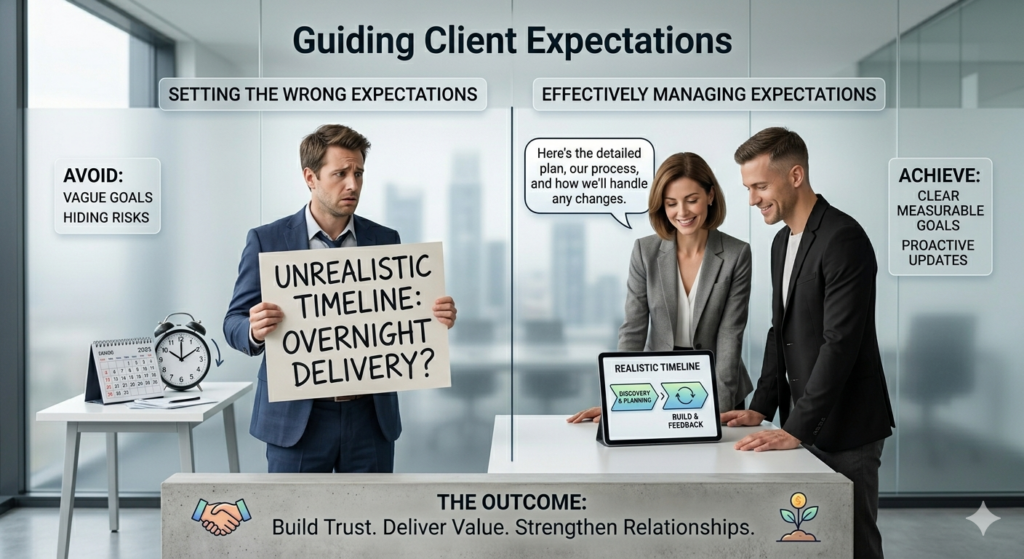
Why client expectations go off the rails (and who’s actually responsible)
Most agencies blame the client.
“They kept changing their mind.”
“They didn’t know what they wanted.”
“They approved it and then said they hated it.”
Sometimes that’s true. But more often, the client’s moving target is a symptom of something that happened weeks earlier: the agency never established a shared, specific definition of what good looks like.
A recent study of over 100 digital marketing professionals found that 41.1% struggle with managing client expectations. The root cause almost always traces back to a weak discovery phase. Not a difficult client. A skipped step.
The uncomfortable truth: expectation problems are a process failure before they’re a people failure.
When a client says “this isn’t what I envisioned,” they’re usually right.
They just never had the opportunity to articulate the vision clearly, and you never had a system to extract it.
That’s the fix.
Build the system.
The expectation debt framework
Here’s a way to think about expectation management that changes how you run projects.
Every time you leave something ambiguous, a vague deliverable, an unconfirmed timeline, a “we’ll figure it out” moment, you’re taking on expectation debt. Small gaps compound.
A vague scope clause becomes an out-of-scope revision request.
An undefined approval process becomes a three-week feedback loop.
An assumed deliverable format becomes a full redesign.
Like financial debt, expectation debt doesn’t disappear. You either pay it down proactively through clear documentation and early conversations, or it collects interest in the form of revision rounds, client resentment, and scope creep you can’t bill for.
The goal of this guide is to show you exactly where expectation debt accumulates, and how to eliminate it before it starts compounding.
How to set expectations before the project starts
This is where most of the work happens. Get this right, and the rest of the project is dramatically easier to manage.
Write a scope of work that actually prevents scope creep
Most SOWs list what you’ll deliver. The problem: they don’t define the edges.
A scope of work that prevents scope creep has two columns, not one. It defines what’s in scope and what’s explicitly out of scope. Both. In the same document.
For a branding project, “out of scope” might include: motion graphics, brand guidelines for sub-brands, social media templates, print specifications. For a web project: copywriting, SEO optimization, third-party integrations not listed in the proposal, future feature requests.
Clearly defining what’s included and adding a section for what is explicitly out of scope is your agency’s best defense against the scope creep that kills timelines and exhausts your team.
The reason agencies skip the “out of scope” column is that it feels confrontational.
It isn’t.
It’s professional.
It signals that you’ve done this before, that you protect your team’s time, and that you take your commitments seriously. Clients who trust you feel safer, not more restricted, when they see clear boundaries.
What a strong SOW also defines:
- Number of revision rounds included (e.g., “two rounds of revisions per deliverable”)
- What constitutes a revision vs. a new request
- Who can approve work on the client side (one named stakeholder, not “the team”)
- Format of final deliverables (file types, resolutions, handoff method)
- What happens if the client misses a feedback deadline
That last one matters more than most agencies think. If you don’t define what happens when the client goes quiet, you absorb all the risk when they resurface two months later wanting to pick up exactly where you left off.
Run a discovery session that surfaces hidden expectations
A kickoff call is a meet-and-greet.
A discovery session is a working session designed to uncover what the client actually wants, including the things they haven’t said yet.
Most clients know what they want in the way someone knows they want “a good restaurant.” The job of discovery is to find out whether that means sushi or steak, a quick lunch or a three-hour dinner.
The surface request and the underlying goal are rarely the same thing.
These questions pull out what the client means, not just what they say:
On success:
- “If we jump forward twelve months and this project was a massive win, what specific metric has changed?”
- “Who inside your organization will decide whether this was successful? What do they care about?”
On past experience:
- “Have you tried to solve this before? What happened?”
- “What’s the worst outcome you’re trying to avoid?”
On decision-making:
- “Who has final sign-off on the work?”
- “Is there anyone who hasn’t been in these conversations who could change direction later?”
That last question is the one most agencies never ask. Nothing kills a project faster than a stakeholder who shows up in week six with a completely different opinion and the authority to override everyone who already approved the work.
Document every answer. Send a written summary to the client after the session. Make them confirm it.
This is now the shared definition of success that the entire project runs against.
Define “done” before work begins
Vague deliverables are a trap.
“A website redesign” means something different to every person in the room.
Before work starts, define done in terms of:
- Deliverable format: What exactly are you handing over? (e.g., “Figma file with desktop and mobile layouts for 8 pages, exported as a developer handoff with all assets labeled”)
- Success criteria: How will you both know the deliverable is ready? (e.g., “Homepage passes Google PageSpeed at 90+ on mobile”)
- Approval process: Who signs off, how, and by when?
- Completion milestone: What event signals that this phase is closed?
When you make “done” this specific, revision fishing goes away because there’s no ambiguity to exploit. Clients also feel more confident because they can see exactly what they’re getting before they’ve paid for it.

How to maintain expectations throughout the project
Setting expectations upfront is phase one. The harder part is keeping them calibrated as the project moves.
Build a communication cadence clients actually follow
The most common agency mistake: communicating only when something needs to happen. The client’s perspective: silence means problems.
When clients don’t hear from you, they fill the gap with anxiety. That anxiety turns into “just checking in” calls that eat up your team’s day.
A weekly status update eliminates most of this. It doesn’t need to be a meeting. A short email every Friday works, four lines, same format every week:
This week: What was completed Next week: What’s in progress Waiting on you: What you need from the client to stay on track Status: Green / Yellow / Red
The “waiting on you” line does most of the work. It makes client delays visible, on the record, and part of the client’s responsibility rather than yours.
Set this expectation in your kickoff meeting. Tell the client they’ll receive a weekly update every Friday and that you’ll flag any blockers there. Then do it without fail.
How to handle mid-project scope requests
“Can you just add a quick animation to the hero?”
“While you’re at it, could we include a blog section?”
“One more thing, the CEO wants a dark mode version.”
Every agency knows this pattern. And every agency handles it differently, usually based on how much they like the client and how close the deadline is.
Here’s the better approach: treat every out-of-scope request as a decision point, not a judgment call.
When a new request comes in, run it through three questions:
- Is this in the original scope?
- If not, does it affect timeline, budget, or other deliverables?
- Does the client understand that it does?
If the answer to question 1 is no, document the request, explain the impact, and give the client a choice: add it to the project with an adjusted timeline and budget, or log it for a future phase.
The goal isn’t to say no. The goal is to make the cost of yes transparent so the client can make an informed decision.
Most scope creep happens because clients genuinely don’t understand that a “small” addition has real downstream effects. Your job is to make those effects visible, not invisible.
Pro tip: Keep a running “parking lot” document for all out-of-scope ideas that come up during a project. Review it at the end of the engagement. It often becomes the brief for the next project.
How to deliver bad news without losing the client
Timelines slip. Vendors miss deadlines. Designs don’t land the way you hoped.
This is project work. The question isn’t whether something will go wrong. It’s whether you’ll tell the client before or after they notice it themselves.
Always before.
When you’re staring down a tough conversation, don’t wait for the client to notice something is wrong. As soon as you have a handle on the problem, be the one to raise the flag.
The framework for delivering bad news:
- Say it early. The longer you wait, the worse it gets. A delay announced on Tuesday lands better than the same delay announced the day before the deadline.
- Own it. Even if the cause was outside your control, the impact on the client is real. Acknowledge it.
- Bring the solution, not just the problem. Come with a revised plan. “Here’s what happened, here’s why, here’s the updated path forward, here’s the new timeline.”
- Put it in writing. After the call, send a written summary of what was discussed and agreed. This protects both sides.
The agencies that handle bad news well almost always end up with stronger client relationships than they started with. Clients don’t expect perfection. They expect honesty and competence under pressure.
What to do when expectations have already gone wrong
Sometimes you inherit a mess. The project is three weeks in, the client is frustrated, and there’s clearly a gap between what they thought they were getting and what they’re seeing.
Don’t wait for it to resolve itself.
It won’t.
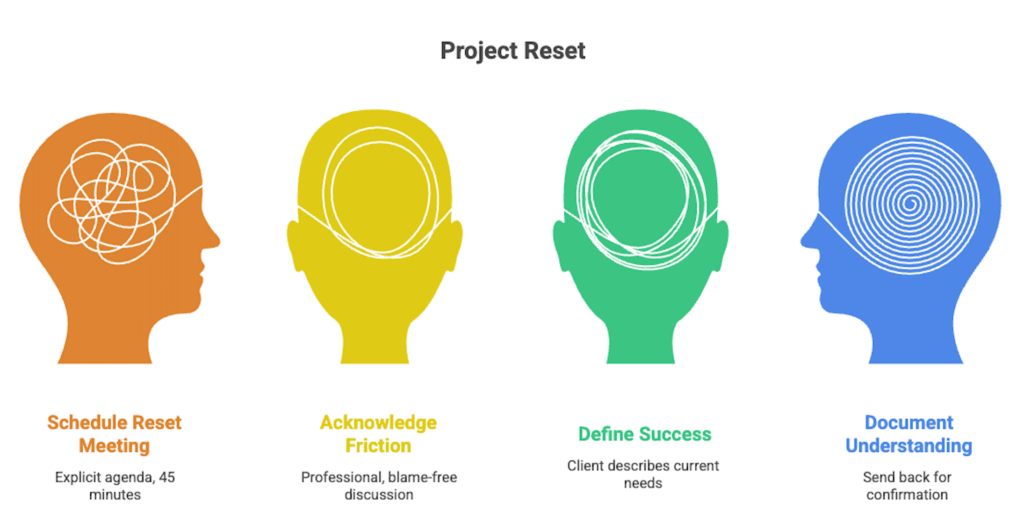
Schedule a reset meeting. Not a status call. A reset.
The agenda is explicit: “We want to make sure we’re fully aligned on where this project is heading. Can we set aside 45 minutes this week?”
In the meeting:
- Acknowledge the friction without blame. “We’ve noticed some back-and-forth on the last two deliverables, and we want to make sure we’re building toward exactly what you need.”
- Get the client to describe success in their own words. Not what they said in the kickoff. What they’d say today, now that they’ve seen early work.
- Document what you hear and send it back to them. “Here’s my understanding of what you’re looking for. Let me know if anything’s off.”
- Reset the plan in writing. Updated scope, timeline, and approval process if needed.
The reset meeting isn’t an admission of failure. It’s a demonstration that you’re a professional who prioritizes the outcome over their own ego.
The tools that make expectation management systematic
The strategies above work at any scale.
But as your agency grows, “remember to send the Friday update” stops being reliable.
You need systems, not intentions.
| What needs to happen | Tool type | Example |
|---|---|---|
| Scope documentation | Proposal / contract tool | Proposify, PandaDoc, or a tight Google Doc template |
| Project tracking | Project management | Upbase, ClickUp, Asana |
| Status updates | PM + communication | Weekly report template in Upbase |
| Scope change requests | PM task + documentation | Change order form logged in Upbase |
| Client approvals | PM or e-signature | Built-in approval flows |
| Meeting notes | Async documentation | Loom, Notion, or Upbase docs |
The goal isn’t to add more tools. It’s to make the right behaviors automatic, so they happen whether you’re having a great week or a terrible one.
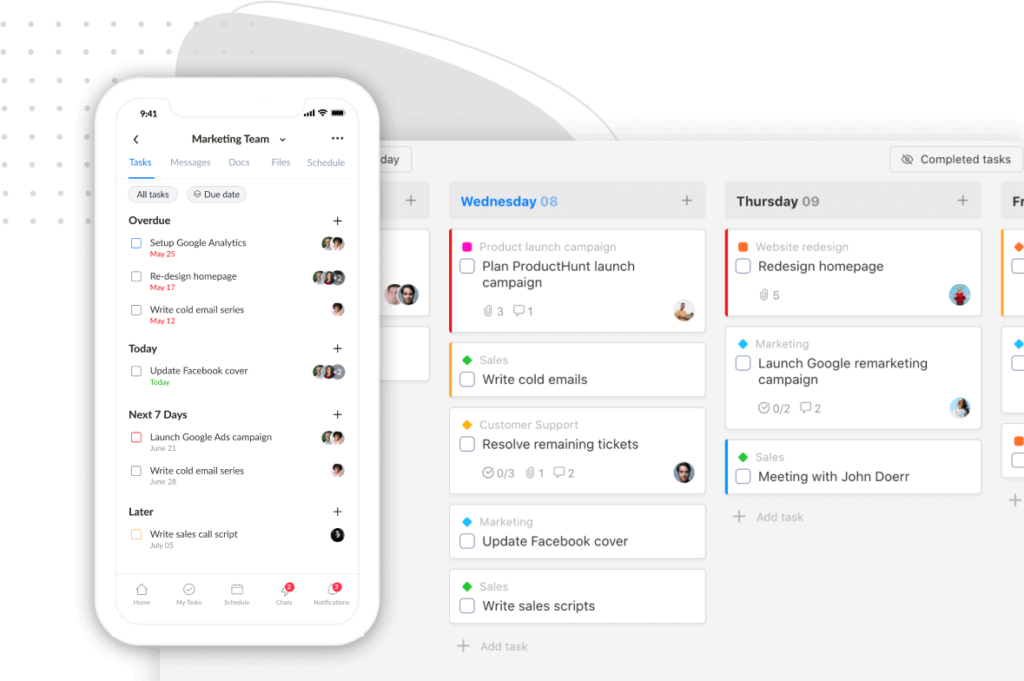
Upbase keeps everything in one place: project timelines, task ownership, client-facing updates, and file handoffs. If your team is managing client work across three different tools and a shared inbox, that’s where expectations fall through the cracks. Try Upbase free →
FAQ
What does “managing client expectations” actually mean?
Managing client expectations means making sure clients have an accurate, specific understanding of what you’ll deliver, when, how, and what they need to do to make it happen, before work starts and throughout the project. It’s not about lowering the bar. It’s about aligning the bar so both sides are measuring the same thing.
When should you start managing client expectations?
Before the contract is signed. The SOW, the discovery session, and the definition of “done” are all part of expectation management. By the time a project kicks off, most of the critical alignment work should already be done.
How do you handle a client who keeps changing their mind?
First, check whether this is a scope problem or a communication problem. If they’re requesting work outside the original scope, apply your change order process. If they’re adjusting work that was already in scope, revisit how “done” was defined. Clients often change their mind because the deliverable definition was vague enough to accommodate multiple interpretations.
What’s the best way to say no to a client request?
Don’t say no. Say “here’s what it costs.” Present the request, explain the timeline and budget impact, and give the client the choice. Most clients aren’t trying to take advantage of you. They just don’t know what a “small addition” actually requires.
How do you set expectations with a client who’s never worked with an agency before?
Spend more time in discovery. Ask about their internal approval process, their communication preferences, and their past experience with projects like this. Explain your process step by step, including what you need from them and when. First-time agency clients aren’t difficult clients. They’re just unfamiliar with how this works.
Start with the SOW. Go back to your last three projects and look at where the friction happened. In most cases, you’ll find it traces to something that wasn’t written down at the start.
That’s the one habit that pays for itself on every engagement that comes after.
If you run an agency, this will feel familiar: Messy client work. No clear profitability. Too many tools. Upbase fixes that!
Start free →